
The Remarkable Story of Saint Blaise and the Soul of Dubrovnik
The Saint Who Watches Over Dubrovnik
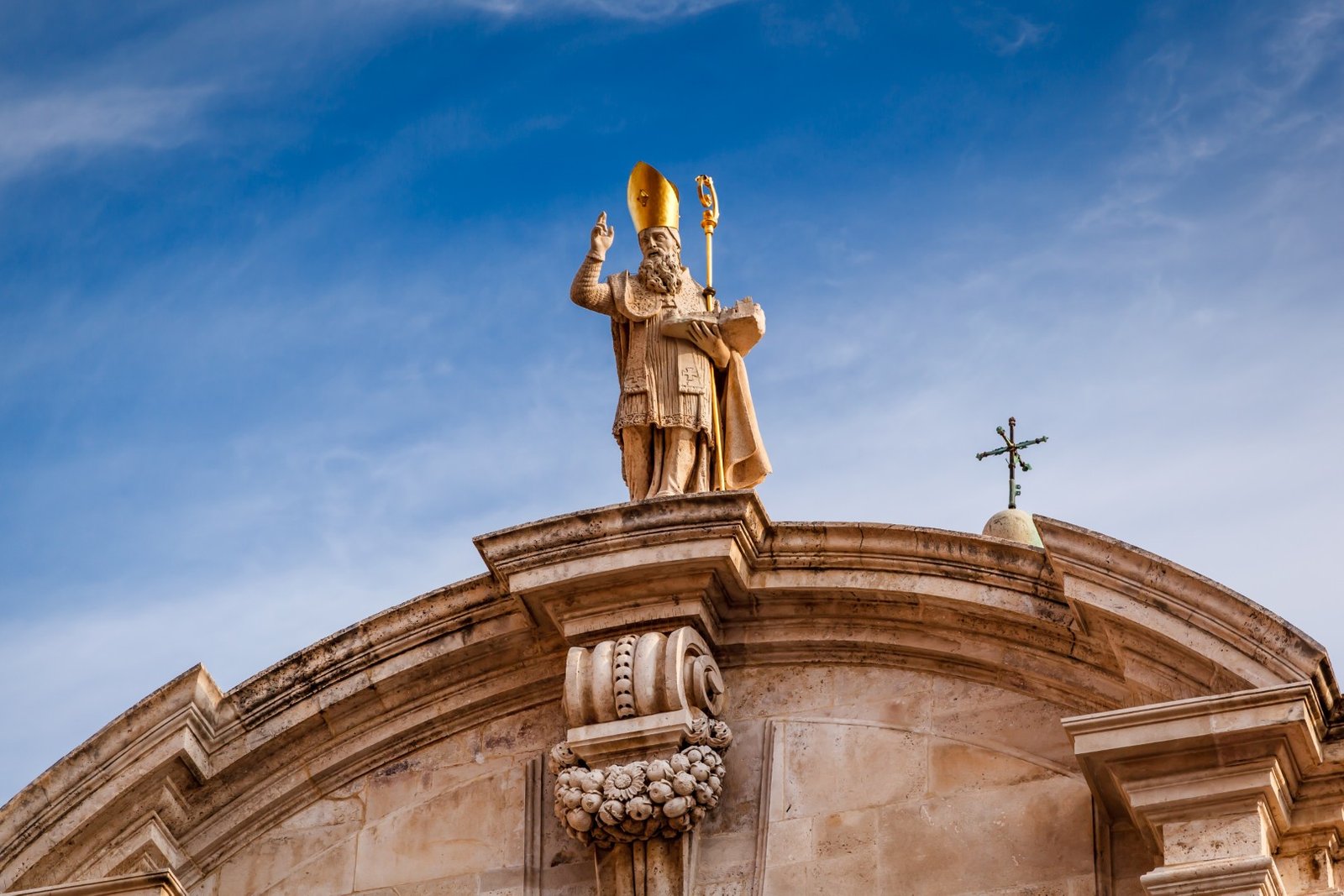
Walk through Dubrovnik and sooner or later you will notice him. He stands above city gates, appears on ancient walls and looks down from stone façades across the Old Town, often portrayed as an elderly bishop holding a miniature Dubrovnik carefully in his hand. This is Saint Blaise — Sveti Vlaho — the patron saint of Dubrovnik and one of the city’s most enduring symbols.
For visitors, he can easily appear to be another beautiful detail among Dubrovnik’s extraordinary architecture. For the people of the city, however, his story is inseparable from Dubrovnik itself. For more than a thousand years, Saint Blaise has represented protection, tradition and a sense of identity deeply connected with the city and its history.
The Night That Became a Legend
The story begins more than a thousand years ago. According to Dubrovnik tradition, Venetian ships appeared near the city in 971, officially stopping to take on supplies before continuing their journey east. Their intentions, however, were believed to be very different.
Legend tells that Saint Blaise appeared to a local priest and warned him that the Venetians were preparing an attack. The authorities were alerted, the city gates were closed and Dubrovnik prepared its defences. With their plans discovered, the Venetian ships eventually sailed away.
The following year, in 972, Dubrovnik began celebrating Saint Blaise as its protector, beginning a relationship between the saint and the city that would survive the Republic itself. Whether encountered as history, faith or legend, the story reveals something important about Dubrovnik: the city’s identity has always been closely connected with protecting its independence.
The Man Behind the Symbol
Saint Blaise’s story began far from the Adriatic. He was a bishop and martyr associated with Sebaste, in what is now Türkiye, and devotion to him eventually spread throughout the Christian world. Dubrovnik developed an especially strong connection with the saint, and relics associated with him were brought to the city.
Yet Dubrovnik made Saint Blaise distinctly its own. In sculptures and images around the Old Town, he is often shown holding a model of the city, complete with its walls and towers. Once you recognise him, you begin to notice his presence throughout Dubrovnik — watching from gateways, churches and centuries-old stone façades.
A Saint Carved into the City
Saint Blaise is not hidden away inside a single church. His presence is woven into Dubrovnik’s architecture, appearing above gates, on fortifications and across some of the city’s most important buildings.
During the Republic of Ragusa, his image carried meaning beyond religion. Saint Blaise became closely connected with Dubrovnik’s independence and civic identity, representing the city wherever his image appeared. Long before modern logos or city branding existed, Dubrovnik already had a remarkably powerful symbol: its protector holding the city in his hands.
When the City Belongs to Saint Blaise
Every year at the beginning of February, the relationship between Dubrovnik and its patron becomes impossible to miss. The Feast of Saint Blaise reaches its heart on 3 February, when Dubrovnik celebrates both its patron saint and the Day of the City.
People arrive from Dubrovnik and the surrounding communities carrying colourful parish banners, while traditional costumes, church bells and ceremonial processions transform the historic centre. Relics of the saint are carried through the streets as residents and visitors gather along the route, continuing customs that have been passed from one generation to another.
For a city so strongly associated with summer, seeing Dubrovnik during the Festa offers a completely different experience. There is no summer heat rising from the stone streets and no stream of beachgoers heading towards the sea. Instead, Stradun fills with banners, bells, families and traditions that belong to the people who call this region home.
It is one of those occasions when the Old Town feels less like a famous monument and more like what it has always been — the heart of a living community.
A Tradition Passed Through Generations
What makes the Festa particularly remarkable is not simply its age, but the fact that the tradition remains alive. Parents bring children who may one day bring their own, parish banners return year after year, and ceremonies, songs and customs continue to connect modern Dubrovnik with generations that walked the same streets centuries before.
In 2009, UNESCO inscribed the Festivity of Saint Blaise, the Patron of Dubrovnik on the Representative List of the Intangible Cultural Heritage of Humanity. UNESCO highlights the way the celebration brings together religious devotion, civic identity, traditional customs and community life, preserving a sense of continuity that has survived through centuries of change.
This is what makes the Festa different from something preserved only in museums or history books. It is not simply heritage remembered. It is heritage still lived.
More Than a Religious Celebration
To understand the Festa only as a religious event would be to miss part of its meaning. Saint Blaise belongs to Dubrovnik’s churches, but he also belongs to its streets, walls and civic identity.
For centuries, the celebration has brought together people from the city, nearby villages and the wider Dubrovnik region. Traditional costumes, banners, rituals and processions all form part of the occasion, but beneath them lies something even more enduring — a shared connection with the city and its past.
That feels particularly appropriate for Dubrovnik. This was once a small republic that placed extraordinary value on its freedom and independence, and Saint Blaise became one of the symbols through which that identity was expressed.
Look Up When You Walk Through Dubrovnik
Most visitors naturally look towards Dubrovnik’s great landmarks — the city walls, Stradun, the bell tower, the old harbour and the Adriatic beyond it. But occasionally it is worth looking a little more closely at the stone around you.
Above a gate or carved into an old façade, you may find an elderly bishop holding a tiny walled city. Once you know his story, those figures are no longer simply architectural decoration. They become part of a much longer story connecting today’s Dubrovnik with the city that existed here centuries ago.
The same is true of the flags that appear throughout the city and the celebration that fills its streets every February. What may initially seem like a small historical detail gradually reveals itself as one of the strongest symbols of Dubrovnik.
Still Watching Over the City
Empires disappeared, the Republic of Ragusa came to an end, and Dubrovnik endured earthquakes, wars and centuries of change. Saint Blaise remained. His image still watches over the gates, walls and streets of the Old Town, just as generations of Dubrovnik citizens have imagined him doing for more than a thousand years.
Visitors may first come to Dubrovnik for its walls, the Adriatic and the beauty of the Old Town. Yet look a little closer and another figure is always there — high above a gate, carved into stone or carried through Stradun each February.
Leave a Reply